Our good friend Samuel, is most interested in the new
Loftur: background notes INLreads
1874: Samuel Kneeland at Thingvellir

Samuel Kneeland has much to say about Iceland and his experiences in and around Reykjavik but he is in Iceland to observe and participate in the action so he and his party head for Thingvalla. He says,
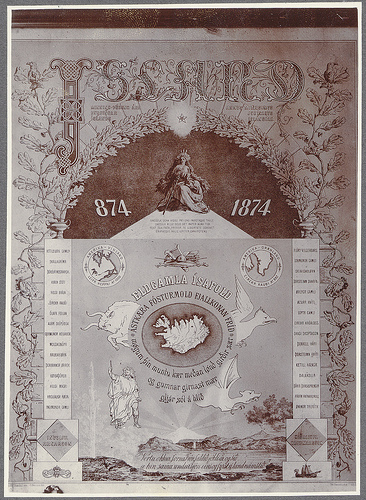
1874: Beginning the millenium celebrations
Today, the church and its ministers are barely tolerated or totally ignored. At one time, they held an important place in society and, particularly, Icelandic society. The ministers were educated, having gone to upper classes in Reykjavik and even Copenhagen. Society, having thrown over God for the newer god of Technology, now has little time for religion in Iceland or North America. The Lutheran church has, I
1874: Kneeland, stormy trip
How easy it is nowadays to travel to Iceland. Hop on a charter and fly over the Pole. Or even take a regularly scheduled flight from Seattle or Minneapolis. The most one can complain about is seats that are a bit tight, or some turbulence. A few years ago a plane was hit by lightning but no one was the worse for it. There
Samuel Kneeland: arrival in Iceland, 1874
When I introduced you to my friend, Samuel, I mentioned that he liked Iceland and Icelanders. He brings an American attitude with him. He is not a member of British nobility but an American medical doctor, a bit of an adventurer. He
Background notes: The Troll Wife
Folk tale collections often include stories of wishes gone wrong.
Many cultures have stories about the danger of making wishes based on greed or pride.
Sometimes, though, they are about wishes gone right. Those are usually about rewards for those whose behaviour is exemplary.
My friend, Samuel Kneeland
Benedikt Gr
Austurvelli

In diplomacy, momentous decisions are often made not in the heat of battle or even argument but over the dinner table, at celebrations, in nooks and corners, by men (in 1874, it was all men) dressed formally and immaculately. The appearance belies the raging undercurrent, the years of meeting, negotiating, the successes and failures, the vested interests.
King Christian IX arrives in Iceland, not as a conqueror but as an absent and distant king. Iceland has not suffered conquest and war but centuries of neglect and exploitation. It has been seen by the Danes as little more than colony from which some profit might be extracted. However, unlike the natives of South America, they are not enslaved to work in the gold mines. There are no gold mines. There are, for a time, sulphur mines but economics means they are abandoned. There are no diamonds, rubies, no minerals, no vast forests that can be used for buildings ships, no exotic spices. There is fish. There is wool. There is meat pickled and smoked. There are horses. None of the products are in great demand, nor does the size of the population mean that what products there are, mostly woolen goods, can be produced in vast amounts.

In 1874, the Danish king, Christian IX, visited Iceland for the first time. He brought with him a constitution for the Icelanders. It was not a document giving them independence but it was a beginning that would eventually lead to Iceland
