Olive Murray Chapman went to Iceland in 1929. She wrote a book, Across Iceland, about her adventure. Nineteen twenty-nine. Between the wars. WWI had ended in 1918, eleven years before her visit. WWII would begin in 1939, ten years after her visit.
Much has changed in Iceland. The most noticeable changes are roads and motor cars, although as her book makes clear, the roads sometimes were dried stream beds and the roads often ended abruptly. Waiting at the end of such road were horses, ready to take her and others to their destinations.
Think of it. An Englishwoman, on her own, not knowing the language, having only a pocket dictionary that was given to her by a friend. Her assets are self-confidence, good health and flexibility.
She starts out by taking a taxi from Edinburgh to the docks at Leith. She finds the Br
Ebenezer Henderson was the first British traveler to stay over a winter in Iceland. Other travelers had come but they stayed only during the summer. To stay longer was to risk being trapped by the weather. Raging storms regularly sank sailboats. There are many reports of foreign fishing vessels being sunk with no survivors. The evidence of such shipwrecks came in bits and pieces washing onto shore.
There were no Inns in Iceland, no hotels as in mainland Europe. There were no roads. The weather that modern day tourists in Iceland talk about, horizontal rain, sudden bitter cold winds off the sea, having to take a set of warm underwear even though it is summer, all existed and, to make matters worse, today
Travelers on the way to Iceland usually stopped at the Faroes. The descriptions of the Faroese and their houses are similar to what is later described in Iceland but with some surprising differences. Symington, like travelers before him, gets off the boat at Thorshaven and keen observer that he is, has this to say about the town.
The Brits came in the night, landed at Reykjavik with no fuss, no bayonets, no shots fired. They arrived to occupy Iceland because the Nazis had been sending delegations, were showing great interest in Iceland. Their interest was understandable since Iceland was like a great aircraft carrier in the North Sea. It provided a critical link in the supply route from North America to England.
Iceland has never had an army, navy or air force, no experience of warfare and, for centuries were forbidden to carry weapons, so the arrival of the British army occasioned a great deal of curiosity. Efforts were made on both sides to make the occupation as conflict free as possible. There were restrictions on when armed forces personnel could leave their base, on their behavior when off the base.
The problem, however, was that first the Brits and then the Americans arrived in large numbers for such a small country. The soldiers were young, male, had some money to spend, were different. It was inevitable that there would be clashes between young Icelandic men and the soldiers. It was equally inevitable that many of the Icelanders would resent the occupation and the disruption of their lives.
Daisy Neijmann gave a talk at the University of Victoria (sponsored by the Richard and Margaret Beck Trust) during the Learneds on the way that British and American soldiers have been portrayed in Icelandic fiction.
She pointed out that the soldiers were seen by some as engaged in trangressive behaviour exploiting women and children. The victims of this behaviour were women and children. The occupation was described as a fairy tale, a fantasy realm where monsters violated social order. It
The first time I went to Iceland, Finboggi Gudmundsson took me to the farm where my great great grandfather and my great grandfather lived and worked before they left for Amerika.
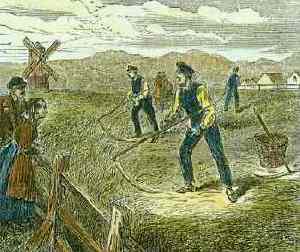
It was one of those fine Icelandic days with no wind off the North Sea, the sky was cloudless, the sun warm. It was the perfect day for making hay and, when we reached the farm, the farmer and his wife were in the hay field.
It was the greatest compliment they could give that they stopped haymaking long enough to serve us coffee and cake and have a brief conversation. I walked the beach were my great grandfather Ketill walked, sat on the stone wall where he used to sit. Then we were away and the farmer and his wife were back to the field making the precious hay for their sheep and cows.
In 1862 when A. J. Symington goes to Iceland, he stops at Thingvalla. They are treated well by the priest, Mr. S. D. Beck (are any of you descendants of his?).




 This entry was posted in